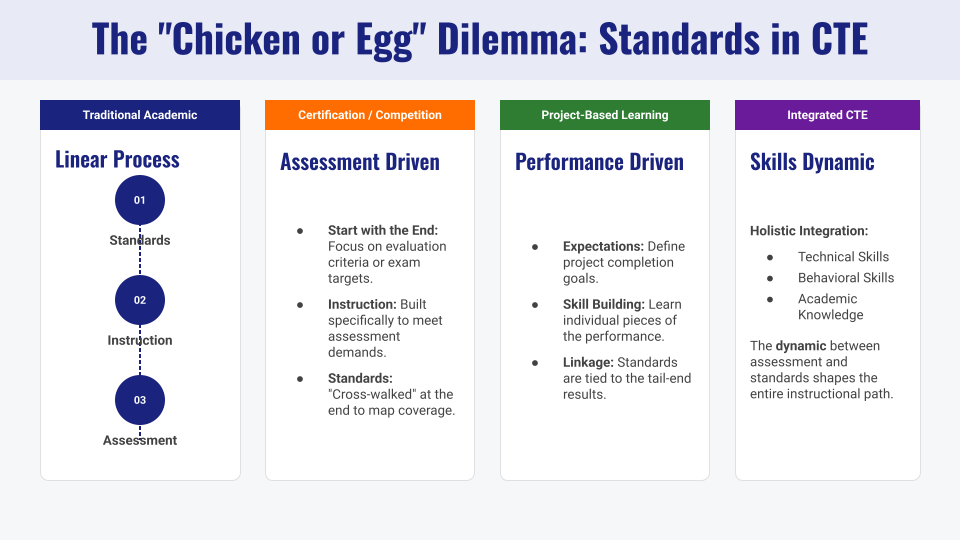
 For most of the past 30 years, education standards have been the compass guiding what students learn. In traditional academic courses, the process is straightforward: start with the standards, build instruction around them, and assess at the end. But in Career and Technical Education (CTE), the relationship among standards, instruction and assessment is far more dynamic – more like a chicken‑and‑egg puzzle than a neat line.
When Assessment Comes First
In many CTE programs, instruction is driven by a certification exam or competition. Think of a cosmetology license or an advanced automotive technology credential: teachers begin planning with the assessment criteria, then work backwards to design lessons that help students meet those benchmarks. Afterward, they “crosswalk” or align what they’ve taught to state and industry standards. The same pattern holds for SkillsUSA events; instructors start with the competition’s evaluation rubric, design student performances to match it, and check which academic standards are covered.
Project-Based Learning: A Different Starting Point
Project-based learning flips the script again. Educators begin by defining what a successful project looks like – whether it’s a middle school community initiative or a senior capstone in a CTE shop. They teach the steps students need to complete the project, and only after students showcase their work do teachers map it back to relevant standards. This approach keeps projects authentic and allows standards alignment without stifling creativity.
Integrating Academics, Technical Skills and Behaviors
Integrating academic content into CTE adds another layer. Beyond technical skills, instructors must consider behavioral competencies (teamwork, professionalism) and academic knowledge (math, literacy, science) that support overall learning. Without assessing all three, teachers tend to focus only on technical outcomes, which can narrow instruction and miss important standards. Effective integration requires a flexible dance between standards and assessment: understanding what knowledge and skills are needed, deciding how to measure them, and then designing learning experiences that deliver both rigor and relevance.
A Dynamic Blueprint
There is no single “correct” order for standards, instruction and assessment in CTE. Sometimes the exam comes first; sometimes the project does; sometimes the standards lead. What matters is that educators are intentional about aligning instruction with both academic expectations and real‑world performance demands, ensuring students leave high school ready for both college and careers.
